FACTORING: A STRATEGIC GROWTH LEVER FOR MID-SIZED COMPANIES
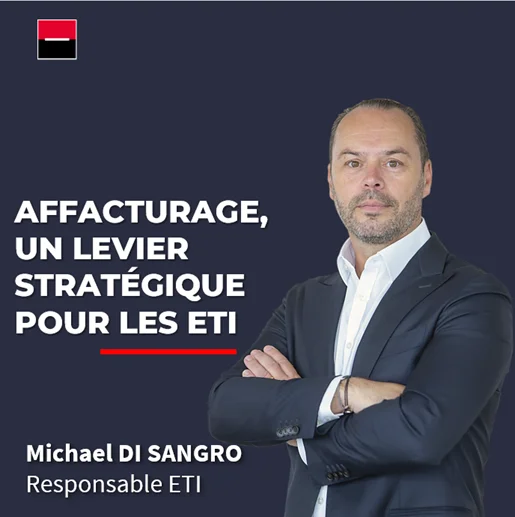
Long associated with short-term financing, it is now emerging as a tool for managing working capital requirement, supporting growth and, in some cases, optimising the financial structure. This evolution is fully aligned with the reality of mid-sized companies, which account for nearly 30% of corporate revenue in France, represent 24% of investment and play a decisive role in exports.
If I had to summarise the benefits of factoring for mid-sized companies in three points, I would say that it enables them to facilitate the management of their working capital requirement, support their international development and optimise the presentation of their balance sheet.
Michael Di SANGRO,
Mid-sized companies: a cornerstone of the French economy
Mid-sized companies play a structuring role in the French economy. According to public data, there are more than 7,000 of them, employing nearly 3.8 million people, generating around €1,466 billion in revenue and close to 30% of export revenue, with an investment rate of 22.0%.
In other words, they occupy a strategic middle ground: sufficiently structured to drive industrialisation, innovation or internationalisation projects, while retaining the agility that sets them apart from large groups.
But this intermediate position also creates a demanding financial equation. Mid-sized companies must finance their growth, absorb sometimes lengthy production cycles, respond to peaks in activity and preserve their investment capacity. In this context, cash becomes a matter of strategic management. The issue is no longer simply to find a source of financing, but to make the accounts receivable position more fluid without making the company’s financial structure more rigid.
From invoice financing to working capital management
This is where the shift in perspective lies. 25% of mid-sized and large companies describe the management of their operating cash flow as difficult, according to the report “France: Cash Management Survey of Large Companies and Mid-Sized Companies” published by AFTE, METI — the French Movement of Mid-Sized Companies — and Rexecode.
With payment delays increasing to an average of 15.3 days in France in 2026, compared with 14.1 days in 2024, and payment terms approaching 50 days — 49.7 days in Q1 2026 — pressure on corporate cash flow is intensifying, limiting companies’ ability to invest and support their growth.
Slowing order books, reduced visibility and financing conditions that remain more restrictive than before the crisis are naturally placing working capital requirement back at the heart of business concerns.
It is in this context that factoring is taking on a new dimension. It is no longer limited to a one-off advance on invoices: it is becoming a cash management tool. By assigning their B2B receivables, mid-sized companies can shorten the time between sale and payment, quickly obtain cash and better smooth out cash flow gaps linked to their operating cycle. Its main advantage is structural: financing follows the company’s real level of activity. The more the company invoices, the more this lever can support its development.
Factoring therefore meets a very concrete expectation from finance departments: access to a flexible solution that is proportional to revenue and can be mobilised quickly. For growing mid-sized companies, those with strong seasonality or those subject to long production cycles, it becomes both a business continuity lever and a development tool.
Growth, seasonality, long cycles: why factoring relieves pressure on accounts receivable
In many sectors, the issue is not a lack of activity, but the gap between expenses incurred and revenue collected. Purchases of raw materials, production, logistics, salaries and sometimes inventory must be financed well before final payment is received. When payment terms commonly extend to 60 days in France, or even longer internationally, this cash flow gap can hinder the ability to increase production, secure supplies or seize a commercial opportunity.
The value of factoring lies precisely in transforming this gap into a manageable variable. It makes it possible to absorb a peak in activity, increase the pace of production or support a commercial ramp-up without waiting for invoices to be paid. Financing no longer relies solely on fixed credit lines or past performance: it is backed by accounts receivable and supports development as it materialises.
30%, the share of French mid-sized companies’ revenue generated through exports
A significant proportion of these companies have operations abroad, which naturally adds complexity to financial flows, collection times and cash management. In a context marked by slowing demand, trade tensions and reduced visibility in international markets, the challenge is no longer only to win new business abroad. It is now also to secure collections, control payment terms and manage cash on an international scale.
This is where export factoring takes on a new dimension. Beyond invoice financing, it addresses several needs at once:
- Financing export invoices;
- Accelerating international collections;
- Securing export receivables;
- Managing invoices in foreign currencies and supporting the financing of subsidiaries abroad.
For finance departments, the benefit is immediate: greater visibility over incoming flows, more stable cash flow and support for growth without mechanically increasing short-term debt.
Mid-sized companies often have a strong international business, whether with export customers or with subsidiaries based abroad. Here again, the challenges are very important for them: securing their export receivables and financing their subsidiaries despite the use of multiple currencies.
Michael Di SANGRO
The value is further reinforced when a company operates in several countries. International factoring programmes can make it possible to centralise the management of accounts receivable, harmonise financing arrangements between the parent company and its subsidiaries, and provide the finance department with a consolidated view of cash flow. Some solutions now offer the ability to operate in several countries, further strengthening the relevance of factoring as a tool to support the internationalisation of mid-sized companies.
Derecognition, financial ratios: the more strategic dimensions of factoring
The third benefit is more technical, but just as structuring. In certain arrangements, particularly non-recourse structures designed for derecognition purposes, factoring can help improve the presentation of the balance sheet. This issue is becoming particularly important in an environment where the quality of financial balances is once again a key criterion for investing, financing external growth or complying with banking commitments.
The Banque de France also notes that between 2022 and 2024, the share of mid-sized companies benefiting from the best credit ratings declined, reflecting a more demanding financial environment. Factoring is therefore no longer merely an operational tool; it is becoming a lever for financial structuring.
For some mid-sized companies, particularly in contexts of transformation, leveraged buyouts or rapid internationalisation, this dimension can have a direct impact on future room for manoeuvre.
From a product-based approach to a programme-based approach
This is where the real change in perception lies. For mid-sized companies, factoring can no longer be approached as a standard product. It must be considered as a factoring programme built according to the company’s sector of activity, financial maturity, international exposure, seasonality and balance sheet constraints.
In other words, factoring is no longer limited to addressing a temporary cash flow pressure. It is part of a broader reflection on how to finance growth, secure flows and better manage cash. It is this tailor-made approach that explains its changing role within mid-sized companies.
As cash flow challenges become more complex and the development paths of mid-sized companies become increasingly international, factoring is changing in nature. It is no longer merely a form of short-term financing; it is establishing itself as a lever for working capital management, growth and financial structuring.
For mid-sized companies, the real question is therefore no longer simply: “How can we finance our invoices?” but rather: “How can we build a factoring programme aligned with our growth strategy, international development and balance sheet challenges?”
To find out more, listen to the Societe Generale Factoring podcast dedicated to factoring as a development lever for mid-sized companies.
FACTORING AND YOU BY MICHAEL DI SANGRO
Next episode : Factoring for LBOs